


AdriaMove_Thursday
THE LIGHTS OF FASANO
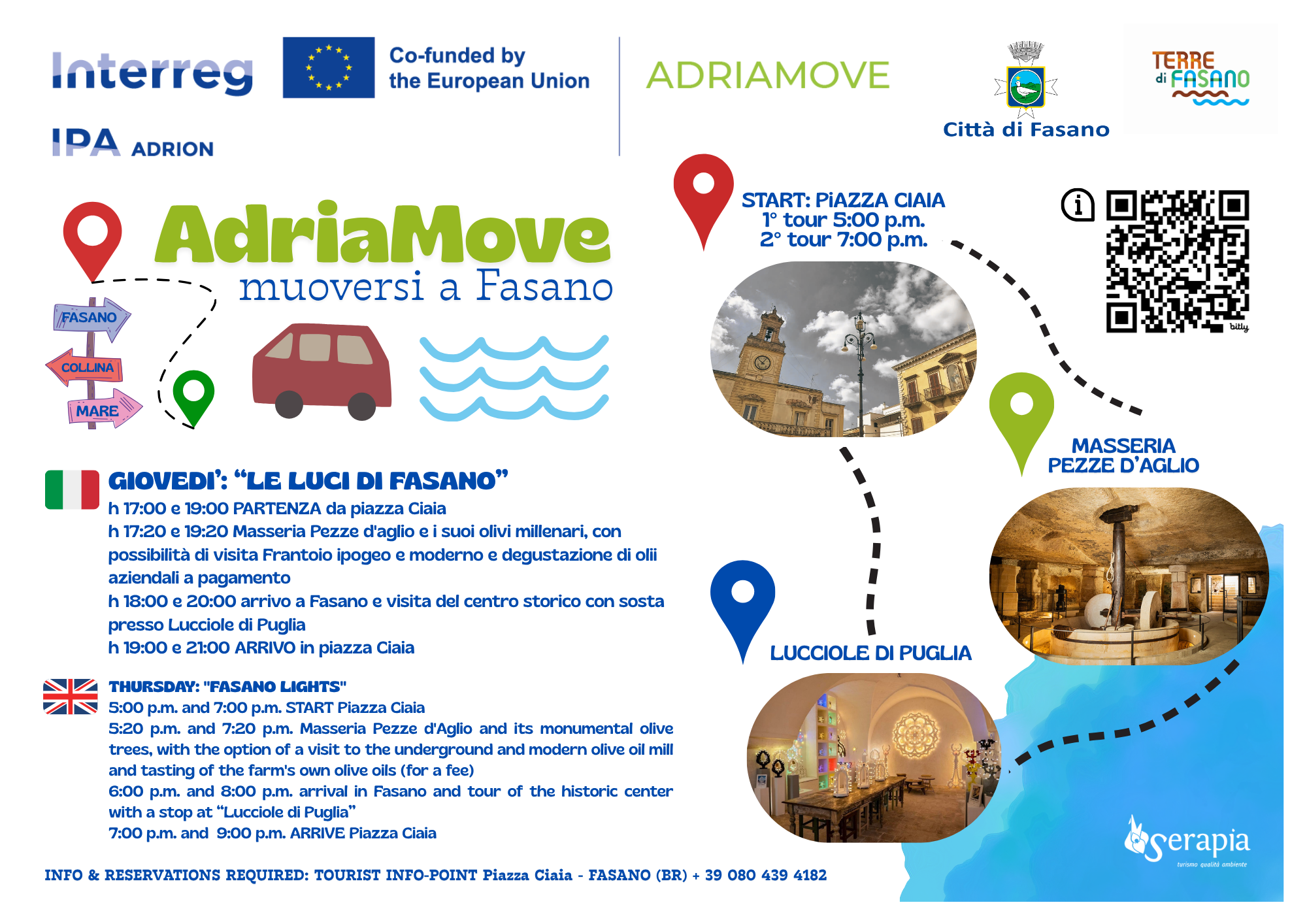
Piazza Ciaia was and remains the beating heart of Fasano. An elegant square where you'll recognize the true soul of the local community and its historical memory. Among various cultural and social symbols of identity, you'll recognize the civic coat of arms on its white limestone paving: a faso or wild pigeon surrounded by the Maltese cross.
In fact, governed by the Knights of Malta for 500 years, Fasano had a castle in this square, on the site of the current Town Hall, which served as the residence of the Balì and the residence of the Knights' military garrison.
The entire Piazza Ciaia is dominated by many public and private buildings of great architectural value, including Palazzo Bianco and Palazzo Gaito, with its statue of the Madonna del Pozzo, the city's patron saint. Also noteworthy is the Clock Tower, home to the University, with its large loggia and current tourist information point. Then there's the late 16th-century church of San Nicola, the corner of Palazzo Mogavero-Pepe with its elegant loggia, and Palazzo Brandi-Latorre, built in the second half of the 19th century.
But if you skirt the Town Hall, heading north, you'll find yourself in the center of the city's main avenues, Corso Vittorio Emanuele, where you'll notice other palaces, churches, and houses in the Fasano style. On the seafront, you'll find the elegant Corso Garibaldi, known by the locals as Corso dei Colucci, due to the imposing Palazzo Reale-Colucci in its central location.
Continuing towards Pezze di Greco, you reach Masseria Pezze d'Aglio. Its history begins with an underground olive oil mill and a medieval rock settlement. The Masseria Pezze d'Aglio, which houses the olive oil mill, dates back to the 1700s. Since 1909, the Savoy family has owned the farm and the olive oil mill. The estate extends over sixty hectares and boasts 10,000 olive trees, 2,500 of which are centuries-old. The main cultivars grown on the farm are centuries-old Ogliarola, Leccino, Coratina, Peranzana, Frantoio, and Picholine. Since 2009, we have also been planting "Senatore Cappelli" durum wheat on our land, from which we obtain high-quality semolina.
Here, we recommend a stop to enjoy the monumental olive trees, visit the Olive Oil Museum set up in the underground olive oil mill, and purchase or taste the company's olive oils.
Once back in Fasano, you can take a guided walk through the historic center to admire the beauty of the historic architecture, arriving at an ancient carpentry shop and, even before that, an underground olive oil mill, now home to Lucciole di Puglia, the workshop of a young artisan who creates truly unique handmade artisan lightings.