



AdriaMove_Monday
CHEESE FASANO
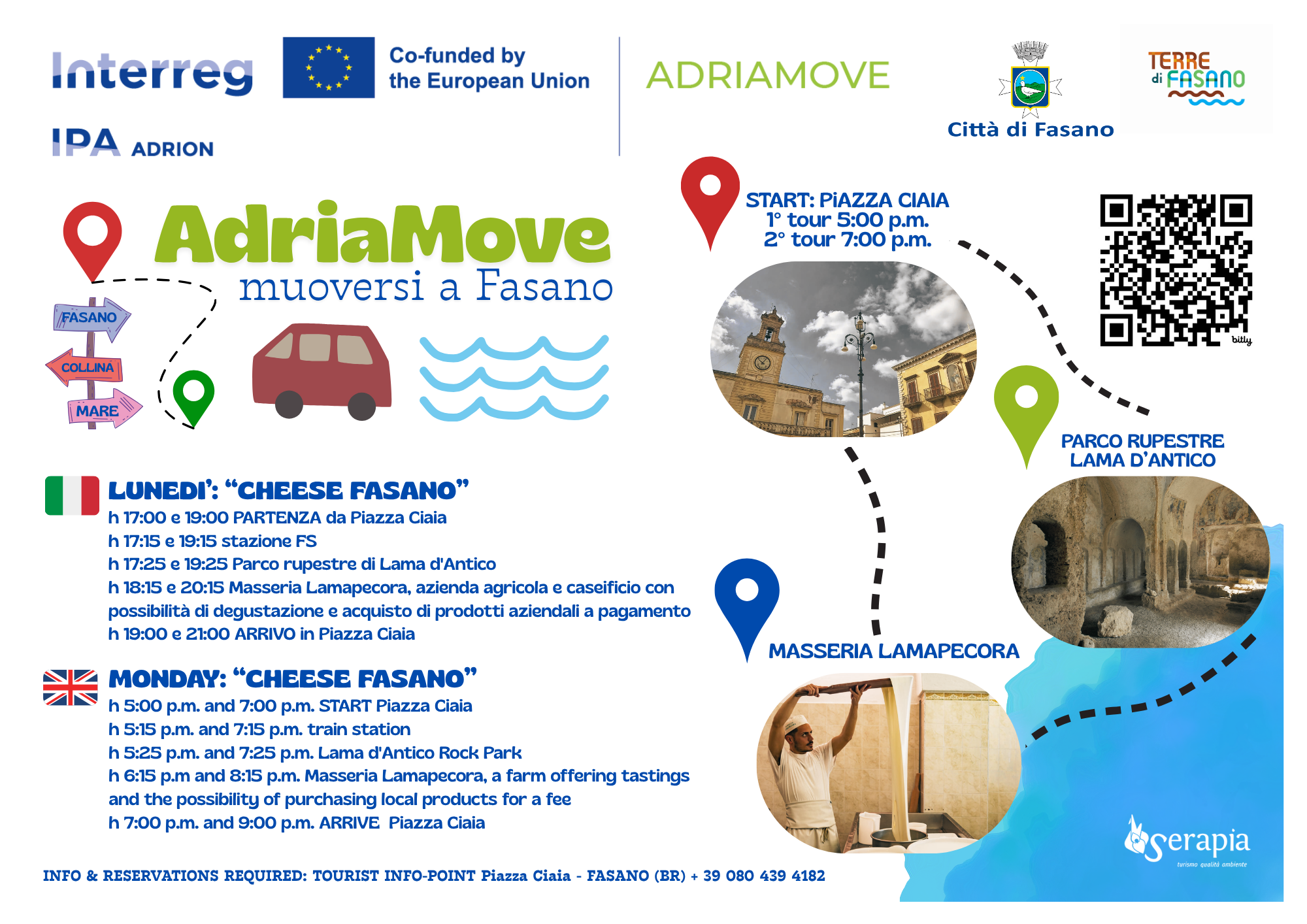
Piazza Ciaia was and remains the beating heart of Fasano. An elegant square where you'll recognize the true soul of the local community and its historical memory. Among various cultural and social symbols of identity, you'll recognize the civic coat of arms on its white limestone paving: a faso or wild pigeon surrounded by the Maltese cross.
In fact, governed by the Knights of Malta for 500 years, Fasano had a castle in this square, on the site of the current Town Hall, which served as the residence of the Balì and the residence of the Knights' military garrison.
The entire Piazza Ciaia is dominated by many public and private buildings of great architectural value, including Palazzo Bianco and Palazzo Gaito, with its statue of the Madonna del Pozzo, the city's patron saint. Also noteworthy is the Clock Tower, home to the University, with its large loggia and current tourist information point. Then there's the late 16th-century church of San Nicola, the corner of Palazzo Mogavero-Pepe with its elegant loggia, and Palazzo Brandi-Latorre, built in the second half of the 19th century.
But if you skirt the Town Hall, heading north, you'll find yourself in the center of the city's main avenues, Corso Vittorio Emanuele, where you'll notice other palaces, churches, and houses in the Fasano style. On the seafront, you'll find the elegant Corso Garibaldi, known by the locals as Corso dei Colucci, due to the imposing Palazzo Reale-Colucci in its central location.
Continuing east, you'll take a road that leads to the sea, passing the local train station and then Largo Oronzo Guarini, where you can admire the wonderful Palazzo Colucci-Guarini, linked to Fasano's olive-growing history.
Immediately after the train station, you'll find the Lama d'Antico Rock Park, where you can stop for a short visit.
Considered among the largest rupestrian area in the region, the Lama d'Antico cave settlement offers a captivating experience in a natural and archaeological setting dotted with truly unique centuries-old olive trees.
It was populated as early as the 10th century AD, although some archaeological finds in the area suggest a continuous settlement from prehistory to the dawn of the modern age.
The beauty of the walk along the ridges of the Lama, a fossil river now rich in Mediterranean flora and fauna, will take your breath away. Your gaze will be drawn to the many natural and artificial cavities of varying sizes and shapes.
The cave dwellings have something mysterious about them, connected in a spontaneous system and in perfect harmony with the natural setting. They can be found at different heights, linked by paths and steps carved into the tuff. You won't miss the sight of water collection systems, cisterns, vents, chimneys, niches for a variety of uses, as well as benches and beds where the inhabitants of these places rested. There are also work areas such as oil mills and granaries, once essential to the settlement's rural economy.
In particular, the church of Lama d'Antico awaits your eyes. Built in the central, elevated part of the lama, it boasts an imposing façade that was originally completely frescoed. It was once at the center of an important route, near the Via Traiana, a route primarily used by pilgrims heading to the East. The presence of the bishop's throne suggests that the sanctuary served as an important episcopal church. The church must have been completely frescoed, while along the walls from the entrance to the smaller nave, 23 blind arches frescoed with figures of holy bishops have been carved.
In the apse, traces of lighter paintings can be admired, with an 11th-12th-century Deesis depicting Christ enthroned, framed in a mandorla between the Hodegetria (Madonna Nikopoia) and the Forerunner (Saint John the Baptist). Below, traces of the apocalyptic symbols of the Evangelists appear, such as the lion for Saint Mark and the haloed ox for Saint Luke.
For more information: www.lamadantico.it
Continuing through olive groves and historic farmhouses, you reach Masseria Lamapecora. Built in the late 19th century, it is a farmhouse surrounded by over seven hundred centuries-old olive trees, where life is still marked, just as it once was, by the rhythms and activities linked to nature.
Structurally, it is composed of two architectural nuclei: the first, older one, originally used as a storage area and farmers' lodgings; the second, more majestic, multi-level building, is the residence of the owner's family. In addition to the tuff and stone structures, Lamapecora boasts a wealth of spaces designed to house both small and large animals: stables for cows, a sheep pen, a farmyard for chickens, and equipped spaces for goats, pigs, and turkeys.
Enriching the landscape is a garden of citrus trees and flowering plants everywhere.
In the 1970s, the Tauro family purchased the farmhouse and surrounding plots of land to turn it into a farm producing its own dairy products and extra virgin olive oil.
For more information: www.lamapecora.com