



AdriaMove_Tuesday
GO TO THE FARMS
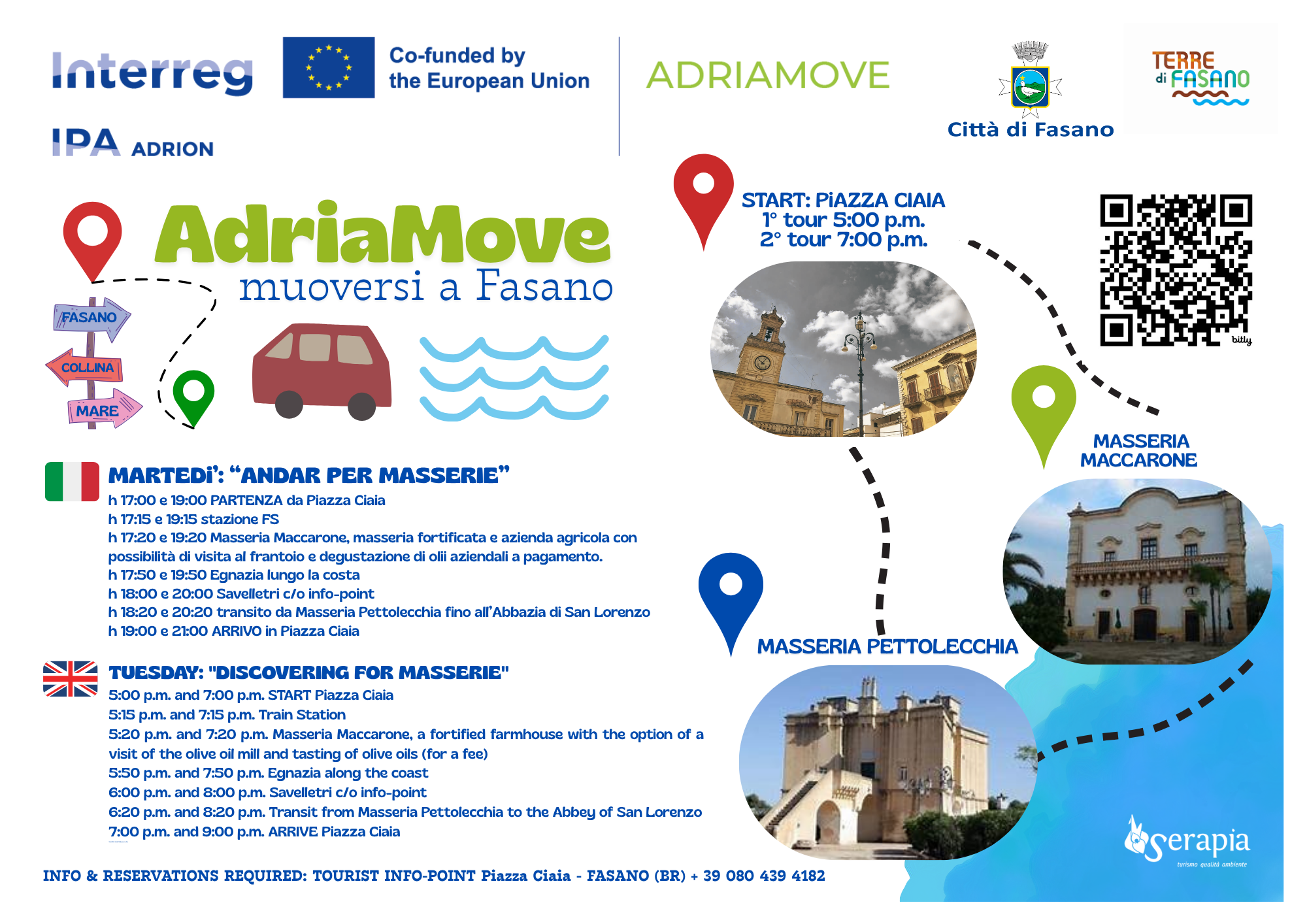
Piazza Ciaia was and remains the beating heart of Fasano. An elegant square where you'll recognize the true soul of the local community and its historical memory. Among various cultural and social symbols of identity, you'll recognize the civic coat of arms on its white limestone paving: a faso or wild pigeon surrounded by the Maltese cross.
In fact, governed by the Knights of Malta for 500 years, Fasano had a castle in this square, on the site of the current Town Hall, which served as the residence of the Balì and the residence of the Knights' military garrison.
The entire Piazza Ciaia is dominated by many public and private buildings of great architectural value, including Palazzo Bianco and Palazzo Gaito, with its statue of the Madonna del Pozzo, the city's patron saint. Also noteworthy is the Clock Tower, home to the University, with its large loggia and current tourist information point. Then there's the late 16th-century church of San Nicola, the corner of Palazzo Mogavero-Pepe with its elegant loggia, and Palazzo Brandi-Latorre, built in the second half of the 19th century.
But if you skirt the Town Hall, heading north, you'll find yourself in the center of the city's main avenues, Corso Vittorio Emanuele, where you'll notice other palaces, churches, and houses in the Fasano style. On the seafront, you'll find the elegant Corso Garibaldi, known by the locals as Corso dei Colucci, due to the imposing Palazzo Reale-Colucci in its central location.
Continuing east, you'll take a road that leads to the sea, passing the local train station and then Largo Oronzo Guarini, where you can admire the wonderful Palazzo Colucci-Guarini, linked to Fasano's olive-growing history.
Immediately after the train station, you'll find Masseria Maccarone. This cultural heritage estate extends for some sixty one hectares (approximately 150 acres). The estate has around twenty thousand olive trees, many ancient, including semi-certificate varieties.
The historical defense walls that surround Masseria Maccarone protect a number of heritage buildings. A 16th century Sheperds House; 17th century Farm House; 1754 Manor House; 1758 Family Church; 1790 Oil Mill and a 1820 Barn.
Within the perimeters of the heritage property but outside the defense walls is a historical Hypogeum (subterranean chamber) with a mill that is still operational. Inside the chamber, still preserved, is an ancient olive oil production system followed by Basilian Monks (330 to 400 AD) of Greek origin.
We recommend a stop for a brief tour of the ancient and modern olive oil mill, with the opportunity to taste and purchase the company's oils.
For more information: www.oliomasseriamaccarone.com
Continuing further towards the sea, we reach Egnazia. The city, cited by classical authors for its privileged geographical position, was a strategic trading post connecting the West and the East. The first settlement arose in the 16th century BC and continued to exist until the Iron Age, when the entire Apulian territory was inhabited by the Iapygians. Around the end of the 6th century BC, Egnazia became a Messapian settlement, corresponding to the present-day provinces of Brindisi and Lecce. Beginning in the 3rd century BC, with the Roman presence in the area, the city underwent urban transformations, and in the 1st century BC it acquired the status of municipium, assuming great importance thanks to the presence of the port and the Via Traiana. From the 6th century BC onwards, In the 13th century AD, the lower part of the town was gradually abandoned, and settlements continued on the Acropolis until the 13th century.
For more information: https://museipuglia.cultura.gov.it/musei/museo-archeologico-nazionale-e-parco-archeologico-di-egnazia/
Going south, you reach the old port of Savelletri, a fishing village and coastal hamlet of Fasano. Here, among the fishermen's houses and excellent seafood restaurants, you can breathe in the scent of the sea and the gentle slowness of those who for generations have chosen to be inspired by the wind and the pleasure of waiting.
After a brief stop for an ice cream or an aperitif by the sea, you continue your tour towards the olive groves and the farmhouses that dot the area all the way to Fasano.
And so, towering above, is the Pettolecchia Castle Farmhouse, the prison of the Knights of Malta and headquarters of the Palmieri family, dedicated to the oil trade throughout the Mediterranean sea; Masseria San Leonardo; Masseria San Lorenzo and the Abbey of Sant'Angelo de' Grecis. The first nucleus of the latter abbey-masseria dates back to the 11th-12th centuries, when it was a Benedictine property dependent on the Abbey of San Nicola di Casole (Otranto); inside is a splendid late 17th-century church, built by Cardinal Giuseppe Renato Imperiale; since 1798, the estate has been owned by the Amati-Colucci family, who have set up an oil museum in the spaces of the ancient underground oil mill, preserving historic machinery and tools from rural life.