



AdriaMove_Martedì
ANDAR PER MASSERIE
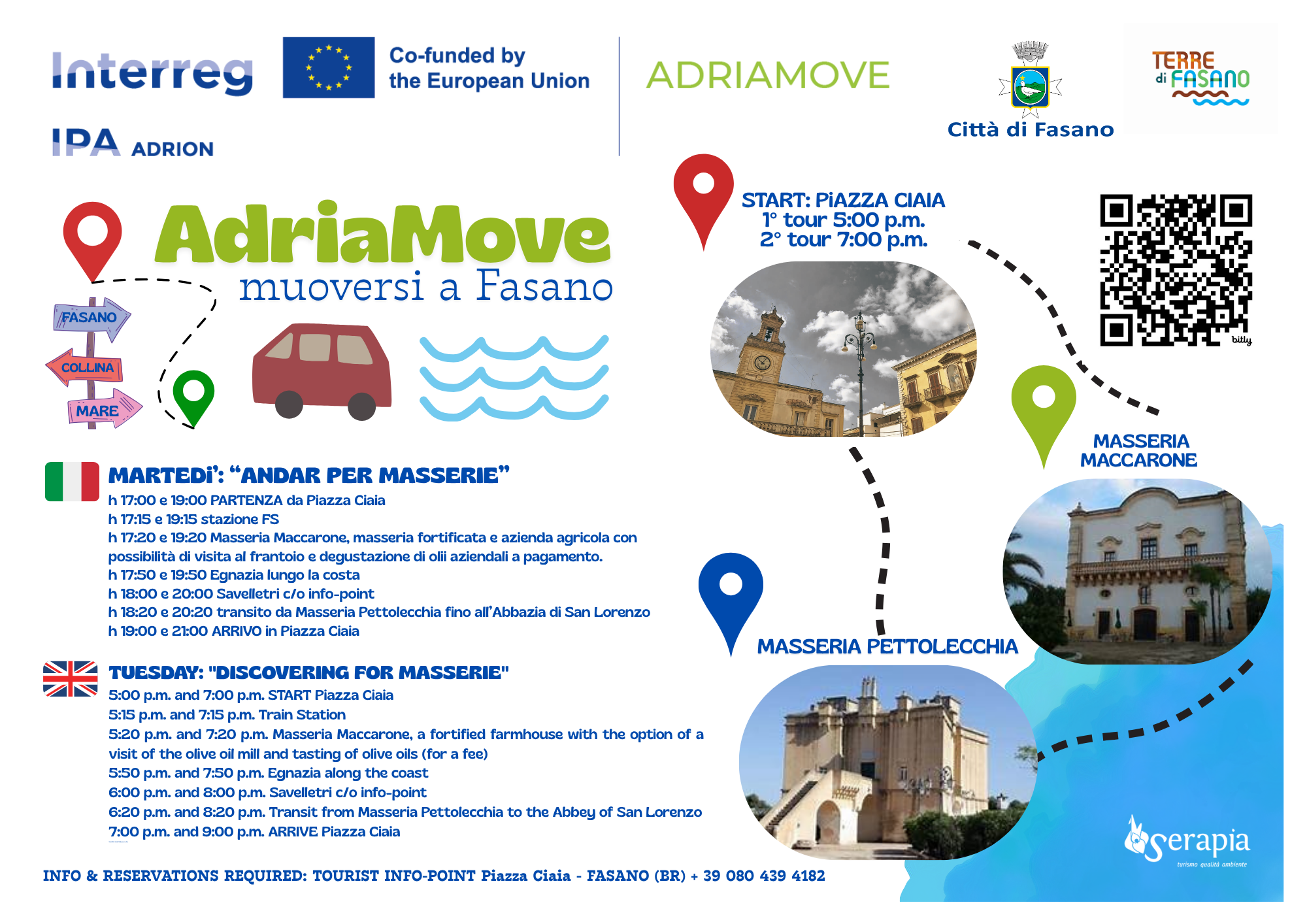
🇮🇹 Piazza Ciaia era e resta il cuore pulsante di Fasano. Un “salotto” elegante in cui riconoscerai la vera anima della comunità locale e la sua memoria storica. Tra vari segni identitari culturali e sociali, vi distinguerai sul suo pavimento lastricato di bianca pietra calcarea lo stemma civico: un faso o colombaccio attorniato dalla croce di Malta
Governata infatti dai Cavalieri di Malta per lunghi 500 anni, Fasano aveva in questa Piazza al posto dell'attuale Palazzo Municipale, un castello, residenza del Balì e residenza della guarnigione militare dei Cavalieri.
Sull’intera Piazza Ciaia campeggiano tanti palazzi pubblici e privati di grande pregio architettonico, tra cui Palazzo Bianco, Palazzo Gaito, con la statua della Madonna del Pozzo, protettrice della città. Ma anche la Torre dell’Orologio, sede dell’Universitas con il suo ampio loggiato e attuale sede dell’infopoint turistico. e poi la tardo-cinquecentesca chiesa di S. Nicola, l’angolo di palazzo Mogavero-Pepe con la raffinata loggia, palazzo Brandi-Latorre, edificato nella seconda metà dell’800.
Ma se costeggerai il Palazzo Municipale, in direzione nord, ti troverai al centro dei corsi principali della città, corso Vittorio Emanuele, dove noterai altri palazzi, chiese e case alla fasanese, mentre, sul lato mare, imboccherai l’elegante corso Garibaldi, detto dai fasanesi il Corso dei Colucci, per la presenza in posizione centrale dell’imponente Palazzo Reale-Colucci.
Proseguendo verso est, si intraprende una strada che conduce al mare, passando dalla locale stazione ferroviaria e quindi da Largo Oronzo Guarini, in cui sarà possibile ammirare il mirabile Palazzo Colucci-Guarini, legato alla storia commerciale olivicola fasanese.
Immediamente dopo la stazione ferroviaria, ecco Masseria Maccarone. La tenuta, sottoposta al vincolo dei beni culturali, si estende intorno alla semifortificazione per 61 ettari nei quali sono presenti circa 20000 alberi di ulivo. All'interno delle mura di cinta la casa del pastore del 1500, la casa colonica del 1600, la casa padronale del 1754, la chiesetta privata del 1758, il frantoio del 1790 e la stalla del 1820. All'esterno delle mura di cinta, ma sempre all'interno della proprietà, è presente un un ipogeo storico con frantoio (Laura Basiliana), anch'esso millenario, con all'interno ancora conservati i reperti storici dei sistemi di produzione oleicola praticati dai monaci basiliani, di origine greca.
vi è consigliata la sosta per una breve visita del frantoio antico e moderno, con la possibilità di fare degustazioni e acquisto degli olii aziendali.
Scopri di più: www.oliomasseriamaccarone.com
proseguendo ancora verso il mare, si raggiunge Egnazia. La città, citata dagli autori classici per la sua posizione geografica privilegiata, fu scalo commerciale strategico nel collegamento tra Occidente e Oriente. Il primo stanziamento sorse nel XVI secolo a.C. ed ebbe continuità di vita fino all’età del Ferro, quando tutto il territorio della Puglia era abitato dagli Iapigi. Intorno alla fine del VI sec. a.C., Egnazia si connotò come insediamento della Messapia, corrispondente alle attuali province di Brindisi e Lecce. A partire dal III sec. a.C., con la presenza romana nel territorio, la città subì trasformazioni dal punto di vista urbanistico e dal I sec. a.C. acquisì lo status di municipium, assumendo grande importanza grazie alla presenza del porto e della via Traiana. Dal VI sec. d.C. la parte bassa dell’abitato venne progressivamente abbandonata e lo stanziamento continuò sull’Acropoli, fino al XIII secolo.
Scopri di più: Museo e Parco Archeologico di Egnazia
Andando verso sud, si giunge fino al porto vecchio di Savelletri, borgo di pescatori e frazione costiera di Fasano. Qui, tra le case dei pescatori e luoghi di ottima ristorazione del pesce, si respira tanto l’odore del mare quanto una dolce lentezza di chi qui da generazioni ha scelto di farsi ispirare dal vento e dal piacere dell’attesa.
Dopo una breve sosta per un gelato o un aperitivo sul mare, si riprende il viaggio verso la piana olivetata e le masserie che costellano il territorio fino a Fasano.
Ed ecco svettante, la masseria castello di Pettolecchia, sede carcerile dei Cavalieri di Malta e quartier generale della famiglia Palmieri, dedita ai commerci di olio in tutto il mediterraneo; Masseria san Leonardo; Masseria San Lorenzo e l’Abbazia di Sant’Angelo de’ Grecis. di quest’ultima il primo nucleo risale all'XI-XII secolo, quando era possedimento benedettino dipendente dall'abbazia di San Nicola di Casole (Otranto); all'interno si trova una splendida chiesa del tardo Seicento, fatta edificare dal cardinale Giuseppe Renato Imperiale; al 1798 la tenuta è di proprietà della famiglia Amati-Colucci che vi ha allestito negli spazi dell'antico frantoio ipogeo un museo dell’olio che conserva macchinari storici e attrezzi della civiltà contadina.
🇬🇧 Piazza Ciaia was and remains the beating heart of Fasano. An elegant square where you'll recognize the true soul of the local community and its historical memory. Among various cultural and social symbols of identity, you'll recognize the civic coat of arms on its white limestone paving: a faso or wild pigeon surrounded by the Maltese cross. In fact, governed by the Knights of Malta for 500 years, Fasano had a castle in this square, on the site of the current Town Hall, which served as the residence of the Balì and the residence of the Knights' military garrison.
The entire Piazza Ciaia is dominated by many public and private buildings of great architectural value, including Palazzo Bianco and Palazzo Gaito, with its statue of the Madonna del Pozzo, the city's patron saint. Also noteworthy is the Clock Tower, home to the University, with its large loggia and current tourist information point. Then there's the late 16th-century church of San Nicola, the corner of Palazzo Mogavero-Pepe with its elegant loggia, and Palazzo Brandi-Latorre, built in the second half of the 19th century.
But if you skirt the Town Hall, heading north, you'll find yourself in the center of the city's main avenues, Corso Vittorio Emanuele, where you'll notice other palaces, churches, and houses in the Fasano style. On the seafront, you'll find the elegant Corso Garibaldi, known by the locals as Corso dei Colucci, due to the imposing Palazzo Reale-Colucci in its central location.
Continuing east, you'll take a road that leads to the sea, passing the local train station and then Largo Oronzo Guarini, where you can admire the wonderful Palazzo Colucci-Guarini, linked to Fasano's olive-growing history. Immediately after the train station, you'll find Masseria Maccarone. This cultural heritage estate extends for some sixty one hectares (approximately 150 acres). The estate has around twenty thousand olive trees, many ancient, including semi-certificate varieties. The historical defense walls that surround Masseria Maccarone protect a number of heritage buildings. A 16th century Sheperds House; 17th century Farm House; 1754 Manor House; 1758 Family Church; 1790 Oil Mill and a 1820 Barn. Within the perimeters of the heritage property but outside the defense walls is a historical Hypogeum (subterranean chamber) with a mill that is still operational. Inside the chamber, still preserved, is an ancient olive oil production system followed by Basilian Monks (330 to 400 AD) of Greek origin. We recommend a stop for a brief tour of the ancient and modern olive oil mill, with the opportunity to taste and purchase the company's oils.
For more information: www.oliomasseriamaccarone.com
Continuing further towards the sea, we reach Egnazia. The city, cited by classical authors for its privileged geographical position, was a strategic trading post connecting the West and the East. The first settlement arose in the 16th century BC and continued to exist until the Iron Age, when the entire Apulian territory was inhabited by the Iapygians. Around the end of the 6th century BC, Egnazia became a Messapian settlement, corresponding to the present-day provinces of Brindisi and Lecce. Beginning in the 3rd century BC, with the Roman presence in the area, the city underwent urban transformations, and in the 1st century BC it acquired the status of municipium, assuming great importance thanks to the presence of the port and the Via Traiana. From the 6th century BC onwards, In the 13th century AD, the lower part of the town was gradually abandoned, and settlements continued on the Acropolis until the 13th century. For more information: https://museipuglia.cultura.gov.it/musei/museo-archeologico-nazionale-e-parco-archeologico-di-egnazia/
Going south, you reach the old port of Savelletri, a fishing village and coastal hamlet of Fasano. Here, among the fishermen's houses and excellent seafood restaurants, you can breathe in the scent of the sea and the gentle slowness of those who for generations have chosen to be inspired by the wind and the pleasure of waiting. After a brief stop for an ice cream or an aperitif by the sea, you continue your tour towards the olive groves and the farmhouses that dot the area all the way to Fasano.
And so, towering above, is the Pettolecchia Castle Farmhouse, the prison of the Knights of Malta and headquarters of the Palmieri family, dedicated to the oil trade throughout the Mediterranean sea; Masseria San Leonardo; Masseria San Lorenzo and the Abbey of Sant'Angelo de' Grecis. The first nucleus of the latter abbey-masseria dates back to the 11th-12th centuries, when it was a Benedictine property dependent on the Abbey of San Nicola di Casole (Otranto); inside is a splendid late 17th-century church, built by Cardinal Giuseppe Renato Imperiale; since 1798, the estate has been owned by the Amati-Colucci family, who have set up an oil museum in the spaces of the ancient underground oil mill, preserving historic machinery and tools from rural life.
Tags: serapia