


AdriaMove_Venerdì
IL PARCO DUNE COSTIERE
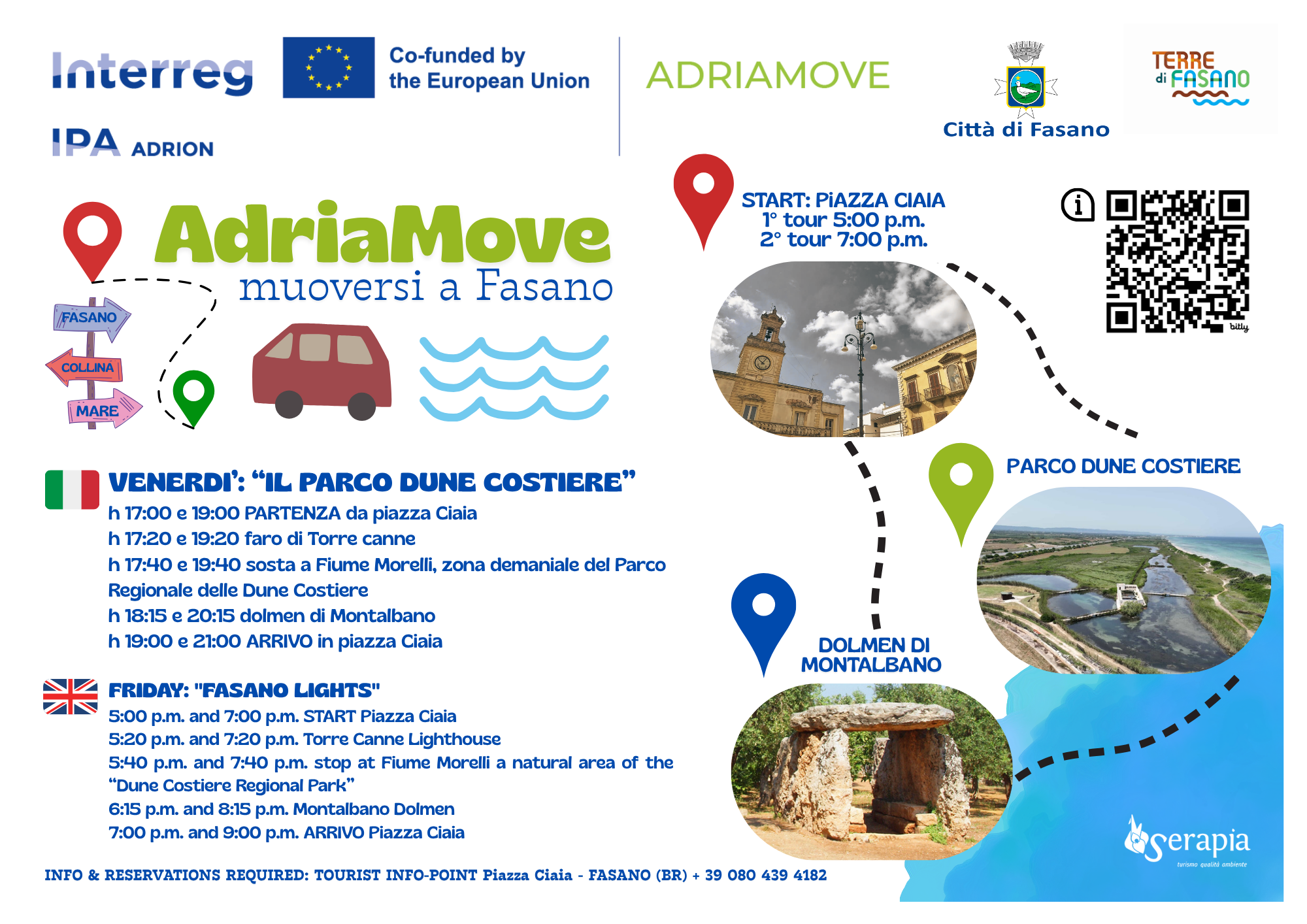
🇮🇹 Piazza Ciaia era e resta il cuore pulsante di Fasano. Un “salotto” elegante in cui riconoscerai la vera anima della comunità locale e la sua memoria storica. Tra vari segni identitari culturali e sociali, vi distinguerai sul suo pavimento lastricato di bianca pietra calcarea lo stemma civico: un faso o colombaccio attorniato dalla croce di Malta
Governata infatti dai Cavalieri di Malta per lunghi 500 anni, Fasano aveva in questa Piazza al posto dell'attuale Palazzo Municipale, un castello, residenza del Balì e residenza della guarnigione militare dei Cavalieri.
Sull’intera Piazza Ciaia campeggiano tanti palazzi pubblici e privati di grande pregio architettonico, tra cui Palazzo Bianco, Palazzo Gaito, con la statua della Madonna del Pozzo, protettrice della città. Ma anche la Torre dell’Orologio, sede dell’Universitas con il suo ampio loggiato e attuale sede dell’infopoint turistico. e poi la tardo-cinquecentesca chiesa di S. Nicola, l’angolo di palazzo Mogavero-Pepe con la raffinata loggia, palazzo Brandi-Latorre, edificato nella seconda metà dell’800.
Ma se costeggerai il Palazzo Municipale, in direzione nord, ti troverai al centro dei corsi principali della città, corso Vittorio Emanuele, dove noterai altri palazzi, chiese e case alla fasanese, mentre, sul lato mare, imboccherai l’elegante corso Garibaldi, detto dai fasanesi il Corso dei Colucci, per la presenza in posizione centrale dell’imponente Palazzo Reale-Colucci.
Proseguendo verso il mare, ecco che si staglia il faro di Torre Canne, faro littorio dove oggi vi è l’infopoint turistico e un piccolo museo del mare. si consiglia una sosta per un gelato o un aperitivo o semplicemente per una passeggiata al porto, dove sarà possibile incontrare i pescatori o godere di una bella vista che spazia fino alla collina di Ostuni.
Riprendendo il tour verso sud, si ripercorrerà la costa che da circa 20 anni è diventata area protetta per la presenza di dune e aree umide di grande interesse naturalistico.
Merita una sosta Fiume Morelli, unica area demaniale del Parco dune costiere, che in verità è un canale a forma di "L" lungo circa 800 metri alimentato da risorgive di acqua salmastra, sfruttate per un antico impianto di acquacoltura (cefali dorati, anguille e orate).
Il Parco dune costiere, esteso per 1200 ettari, è anche un parco agrario: attraverso la scenografica “strada bianca” si giunge al Dolmen di Montalbano, altare sacrificale del II millennio a.C., detto anche Dolmen dei Paladini, vera testimonianza di un’antropizzazione antichissima.
🇬🇧 Piazza Ciaia was and remains the beating heart of Fasano. An elegant square where you'll recognize the true soul of the local community and its historical memory. Among various cultural and social symbols of identity, you'll recognize the civic coat of arms on its white limestone paving: a faso or wild pigeon surrounded by the Maltese cross. In fact, governed by the Knights of Malta for 500 years, Fasano had a castle in this square, on the site of the current Town Hall, which served as the residence of the Balì and the residence of the Knights' military garrison.
The entire Piazza Ciaia is dominated by many public and private buildings of great architectural value, including Palazzo Bianco and Palazzo Gaito, with its statue of the Madonna del Pozzo, the city's patron saint. Also noteworthy is the Clock Tower, home to the University, with its large loggia and current tourist information point. Then there's the late 16th-century church of San Nicola, the corner of Palazzo Mogavero-Pepe with its elegant loggia, and Palazzo Brandi-Latorre, built in the second half of the 19th century.
But if you skirt the Town Hall, heading north, you'll find yourself in the center of the city's main avenues, Corso Vittorio Emanuele, where you'll notice other palaces, churches, and houses in the Fasano style. On the seafront, you'll find the elegant Corso Garibaldi, known by the locals as Corso dei Colucci, due to the imposing Palazzo Reale-Colucci in its central location.
Continuing toward the sea, the Torre Canne lighthouse looms, a fascist lighthouse that now houses a tourist information point and a small sea museum. We recommend a stop for an ice cream or an aperitif, or simply a stroll along the harbor, where you can meet fishermen or enjoy a beautiful view that extends to the Ostuni hill.
Resuming the tour south, you'll retrace the coast, which for about 20 years has been a protected area due to its dunes and wetlands of great naturalistic interest. It’s worth a stop the Fiume Morelli, the only state-owned area in the Coastal Dune Park. It's actually an L-shaped canal about 800 meters long, fed by brackish waters, used for an ancient aquaculture farm (golden mullet, eels, and gilt-head bream).
The Coastal Dune Park, covering 1200 hectares, is also an agricultural park: the scenic "white road" leads to the Montalbano Dolmen, a sacrificial altar from the 2nd millennium BC, also known as the Paladins' Dolmen, a true testimony to ancient human settlement.